
Exposed: The Politics Behind Natural England’s Controversial Badger Cull Licences
- Badger Trust Staff Team

- May 23, 2025
- 8 min read
Badger Trust and Wild Justice expose troubling evidence from a Judicial Review revealing Natural England's controversial badger cull licensing.
After a year of having the full evidence from our Judicial Review against Natural England, Badger Trust, and Wild Justice can now make it public, thanks to Justice Fordham at the High Court in London.
The delay in disclosing these details and discussing their implications is a testament to the need for transparency and accountability. The licenses were granted, the supplementary culls happened, and thousands of badgers were needlessly killed against Natural England’s advice and initial judgment.
At this time, Natural England (NE) is again issuing supplementary cull licenses. Still, neither NE nor DEFRA has disclosed the number of badgers shot under the intensive or supplementary culls that NE licensed throughout 2024/2025. Despite our recent FOI submission, the public remains in the dark about this crucial information, highlighting the need for data transparency in such decisions.
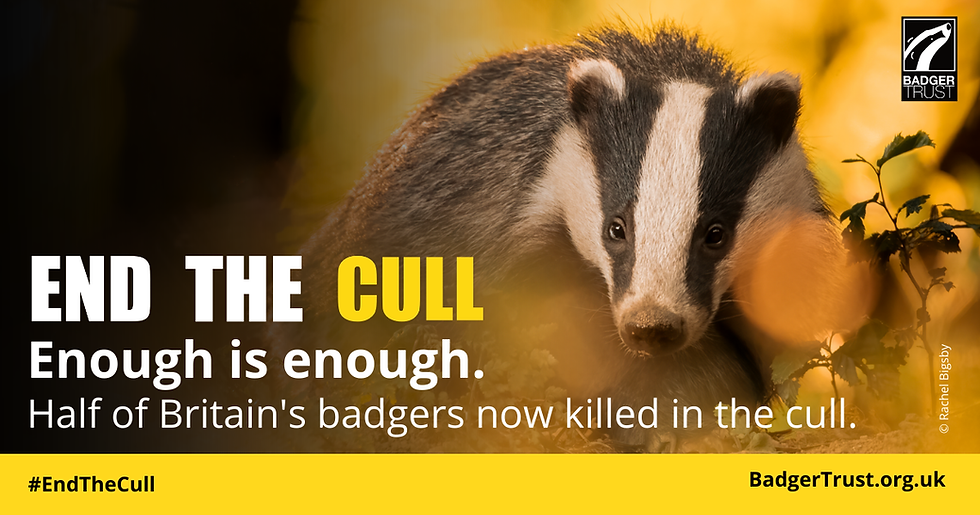
DEFRA admits that it does not know how many badgers are left and is committed to finding out over the coming years. The repeated failure of cull companies to meet their kill targets, combined with local survey information, strongly suggests that the culling policy may not be as effective as it is claimed to be.
Against this background, you might imagine that DEFRA and NE would think long and hard about the evidential basis for granting the killing of yet more badgers. You might imagine that uppermost in their minds would be watertight epidemiological evidence derived from DNA analysis proving that badgers and nothing else were the source of cattle infection in each area where farmers were applying for licenses. The technology exists, it just isn’t used.
The grubby little secret at the heart of this – not shared with participating farmers, taxpayers, Parliamentarians, or voters (in what was guaranteed to be a General Election year) was that Natural England wasn’t going to grant the licenses in 2024.
That was until they had a letter (SB/172/#3) from DEFRA's Director for Food, Biosecurity and Trade, which was strange as that role has nothing to do with science or law.
This letter generously offered them “additional policy context”, explaining that not granting the supplementary cull licenses (described erroneously as “abrupt changes to policy”) would seriously undermine our [DEFRAS] ability to engage constructively with the industry.
DEFRA's directive to Natural England to grant the supplementary cull licenses was clear: 'It’s important to us that you grant the supplementary cull licenses to shore up the farming industry’s confidence in Government policy.' This statement underscores the potential impact of badger culling on the farming industry, urging us to consider the implications of such policies.
Granting supplementary licenses is not part of the cull policy. They are reviewed annually, so cull consortia apply for them at their own risk; there is no guarantee that they will be granted or remain in place.
This is important as in 2024, DEFRA implied that anyone applying for a license would receive one; otherwise, they might lose confidence in government policy.

In whose interest was DEFRA acting? This looks an awful lot like regulatory capture—when a Government department is co-opted to serve the commercial interests of a minority group at the expense of the general public's best interests and the health of our shared natural environment.
Unfortunately for Badgers, the situation worsened when Natural England debated the advantages and disadvantages of following DEFRA's instructions by granting supplementary cull licenses, a discussion recorded under the heading 'stakeholder handling' (SB/201/202).
‘Stakeholder handling’ – not ‘evidence for or against the efficacy of the proposed measure in preventing the spread of disease’, which is the statutory purpose under the Protection of Badgers Act 1992 (Section 10(2)(a)).
Among the concerns for Natural England (NE) were the following:
1. Protecting the relationship between DEFRA and the farming industry and its trade bodies
2. Maintaining industry confidence in government policy.
3. Safeguarding its relationships with DEFRA, the farming industry, and its trade bodies
(specifically mentioning the National Farmers' Union - NFU).
4. Supporting the “farming community.”
5. Managing its budget effectively.
6. Ensuring its staff's well-being and reducing stress levels in case relationships with the farming industry and community were negatively impacted.
Natural England was especially worried that if it upset the farming industry trade lobby, it would be far harder to deliver its nature recovery schemes (SB/203/#4/#5).
It appeared that Natural England, the country’s statutory advisor and protector of wildlife, was hesitant to make evidence-based decisions for fear of industry lobbyists' backlash.
However, this is not in line with its responsibilities under the NERC Act or any other regulations. Implementing successful schemes with the cooperation of willing and interested landowners is possible. As neighbouring landowners observe the benefits of these forward-thinking practices, they are likely to join in as well, much like what happened at the beginning of agri-environment schemes.
Natural England has gathered substantial evidence and formal written advice from its team. Dr. Brotherton, the Director of Science at Natural England, conducted a comprehensive review of the evidence for the organisation. He clearly presented many of Professor Godfray's findings and recommendations in his review. However, it is puzzling that DEFRA has not publicly acknowledged these, particularly regarding the importance of cattle control measures (SB/17/#1-#2).
In Dr. Brotherton's draft paper (SB/207, SB/208), a paragraph pointed out the repeated misreporting of the findings from the Birch analysis. However, this paragraph is missing from the final paper (SB/165). We suspect that DEFRA requested its removal from the final version because it does not align with the carefully protected narrative that has been maintained for so many years.
Dr. Brotherton clarified that Birch did not conclude that badger culling reduced the risk of a bTB breakdown per herd year by 56%. Instead, a combination of several cattle management measures—including more frequent and sensitive cattle testing, stricter cattle movement controls, and badger culling—resulted in the 56% reduction in risk. Birch himself noted that his analysis cannot distinguish between the different measures implemented, similar to findings from previous studies.
Moreover, Badger Trust successfully prompted the then Secretary of State, Steve Barclay, through legal channels to acknowledge that the Birch study highlighted these points. DEFRA also admitted that they could not identify the specific contribution of badger culling to the changes in bTB rates among cattle. However, DEFRA did not communicate this information to the press, Parliament, or farmers.
After all of the debate, Natural England’s Chief Executive Marian Spain seems to have had enough of DEFRAs repeated insistence that despite all of their public promises, nothing but killing badgers would do or could be done and she wrote to NE officials saying “it begs a question as to how long we could use an “alternative exists but not yet being used” argument” (SB/255)
It has been well over a decade, and following repeated Freedom of Information (FOI) requests, DEFRA disclosed in 2024 that they spend only £3-£4 million per year on research and development (R&D). This appears to be a case of foot-dragging. This amount is notably low compared to the £9 million per year that DEFRA allocates to reducing infection risk from badgers and the police's expenditure of over £3.5 million on firearms operations in 2023 alone. To put this into perspective, £12.5 million is roughly what it would cost to pay 500 newly qualified nurses for a year.
The focus on spending a significant amount of money on badger culling is particularly striking, especially considering a 2013 study which established that 94% of all cases of bovine tuberculosis (bTB) arise from cattle-to-cattle transmission, rather than from badgers. A later study 2023 confirmed that 95% of bTB cases resulted from cattle infecting other cattle when the cases were investigated using DNA analysis.
On May 2, 2024, Natural England’s Chief Operating Officer, Oliver Hamar, presented his decision rationale (SB/269) to the Chief Executive and the Chair. He accepted the evidence the Director of Science, Dr. Brotherton, provided, but set it aside due to significant uncertainty surrounding the alternatives to culling.
Hamar emphasised the necessity of maintaining and building industry confidence. This decision raises questions about prioritising the happiness of farmers over the public interest or making evidence-based and rational decisions.
Marian Spain and NE Chair Tony Juniper agreed with these conclusions. Still, it noted that DEFRA needed to move forward with non-lethal alternatives before Natural England was asked to consider further licenses (SB/263/#2).
Natural England could have rejected supplementary licenses several years ago and insisted on implementing non-lethal measures.

The first Godfray review said that greatly improved cattle testing, cattle movement controls, and other cattle measures were required, and an excessive focus on wildlife would simply distract attention from where the real effort must be invested—in cattle.
At the time, DEFRA recognised that if they were to test for bovine tuberculosis (bTB) in cattle reliably, they would likely identify more cases and increase the chances of eliminating the disease from the national herd. They explained a temporary rise in bTB cases and compensation costs in England to the National Audit Office, attributing it to improved testing rather than an increase in actual disease prevalence. This situation is reminiscent of President Trump's handling of COVID-19 during his first term, where he accurately noted that more testing would uncover more cases. DEFRA soon returned to its previous methods in England, resulting in a decline in recorded bTB rates. In contrast, Wales conducts more frequent and reliable testing on its cattle.
On May 10, 2024, Oliver Hamar informed DEFRA about Natural England's decision to issue licenses (SB/277). He expressed frustration, stating that Natural England did not intend to kill protected species "any longer than necessary" and emphasised the need to strengthen the evidence supporting alternative methods.
However, Natural England still decided to kill thousands of badgers unnecessarily, and we argue that this decision was improper. Natural England and DEFRA disagree, but that much is clear. However, it is also clear how much they don’t want to be challenged.
While we await our Judicial Review to be heard in court, we are still waiting for DEFRA or Natural England to publish the kill figures for 2024, both for intensive and supplementary culling.
Typically, these figures are released using convoluted language that often includes the word "effective." This language leads the press and the public to infer that culling badgers has successfully reduced bTB (bovine tuberculosis) in cattle.
However, DEFRA and Natural England do not clearly state in plain English—but make clear in other contexts—that the criteria for determining the 'success' of the badger cull have little to do with the rates of bTB in cattle. It's quite the opposite. The criteria that NE must use in assessing 'success' are outlined here [LINK]: Was the cull carried out safely (i.e., no one was injured)? Did the shooters meet their targets (which they often did not)? And was the shooting accurate?
While Natural England may not be the architects of the badger cull policy, this is a DEFRA policy and a commitment made by the Conservative Party in their 2010 manifesto. Natural England is not obligated to execute the decisions that DEFRA desires.
Natural England can say ‘no’ to the Secretary of State when exercising its powers, as in this case. It doesn’t have to lie down and play dead just in case a multi-million pound trade lobby with its teams of paid Parliamentary lobbyists cuts up rough.
If the Government wants to rebuild trust in politics and participation in democracy, it must start by being honest and open. In our opinion, the government has failed miserably on this issue so far.
Please make a donation to enable us to take on this challenge on behalf of badgers, those charismatic and ecologically essential members of our fauna.
Thank you for any help you can give via the link here: https://www.crowdjustice.com/case/legal-challenge-against-badger-cull-licences/
Thank you to all who have already donated via our newsletter. We will shortly transfer those donations to this crowdfunder.

If, for any unexpected reason, we raise more money than we need to fund this challenge, Crowdjustice will retain the unspent funds and make them available for Wild Justice to use for other similar legal cases on behalf of UK wildlife.
Thank you, from Wild Justice and Badger Trust.


